24 July 2014

Colourful sea anemones and other extraordinary Cnidaria of Vancouver Island

Pachycerianthus fimbriatus, Rock Bay, Canada

In this post I present a few animals belonging to the Cnidaria I found at Vancouver Island, Canada. Apart from the last two species they all belong to the subclass Anthozoa, literally flower animals: the sea anemones (NL: bloemdieren, zeeanemonen).

Urticina grebelnyi, Rock Bay, Canada

Let's start with one of my favourite photo's of the painted anemone, Urticina grebelnyi. I love Urticina species (dahlia anemones, NL: zeedahlia's) with their stout tentacles. Up to 25 cm in diameter and 20 cm high. This small specimen was attached to the jetty at Rock Bay.

Urticina grebelnyi, Cottam Point, Canada

Never heard of Urticina grebelnyi? Neither did I. But the Urticina specimens I photographed looked rather different, so I searched the internet and came upon the website Actiniaria.com of Nadya and Karen Sanamyan (Kamchatka Branch of Pacific Institute of Geography, Russia). It seemed that what I thought were Urticina crassicornis, were not.


Urticina grebelnyi, Deep Cove Bay, Canada

From Actiniaria.com: 'This common North Pacific species often is called painted anemone or Christmas anemone and erroneously identified as Urticina crassicornis. Actually, true Urticina crassicornis is a very different species having absolutely smooth body, while in painted anemone - Urticina grebelnyi - the whole column (body) is covered by numerous nonadhesive vesicles. According to a recent revision of Urticina, the valid name of painted anemone is Urticina grebelnyi.'


Urticina grebelnyi, Rock Bay, Canada

A rather dull coloured/patterned painted anemone.

I asked Nadya and Karen Sanamyan for help. In a very prompt reaction Karen told me all my photo's regarded Urticina grebelnyi, except for one (see further). 

Urticina grebelnyi, Deep Cove Bay, Canada (same specimen as photo below)

Karen Sanamyan: 'I never saw colourless specimens of U. grebelnyi before as on your images, but I nevertheless have no doubt it is this species. The overall habitus is characteristic and a row of white-pearl spherules on the margin is characteristic.' See the band of white markings just below its tentacles (or above, just how you are looking) at the next photo.

Urticina grebelnyi, Deep Cove Bay, Canada

The painted anemones I photographed at Deep Cove Bay were attached to a jetty. Click here for a post about Deep Cove Bay.

Sea anemones are carnivores. Usually the anemones with fewer, more stout tentacles - like the Urticinidae - are the most 'sticky' ones, i.e. the sea anemones with the more potent or plentiful nematocyst (the stinging cells).


Urticina grebelnyi, Cottam Point, Canada

A gorgeous coloured specimen of the painted anemone. Below in detail with partly opened mouth. As you have seen by now, there is a lot of variety in colour and pattern in this species.


Urticina grebelnyi, Cottam Point, Canada

Urticina species, Rock Bay, Canada

This is the odd one out. Karen Sanamyan: 'I can not say to which species this one belongs. It is hexamerous and white bands on the tentacles are arranged in a different way in comparison with Urticina grebelnyi.' 

Cribrinopsis fernaldi, Rock Bay, Canada

I found the next species of this post, Cribrinopsis fernaldi, the crimson anemone, on sandy bottom at Rock Bay; the same biotope as the forthcoming tube-dwelling anemone. I can't recall if it was attached to a rock(s) or shell fragments, but I suppose it must be, otherwise it will drift with upcoming tide to the shore. Up to 30 cm tall.

Cribrinopsis fernaldi, Rock Bay, Canada

Detail with partly opened mouth. The common name is - as is often the case - dull and not very characteristic. What about 'magma anemone'.

Cribrinopsis fernaldi, Rock Bay, Canada


unidentified species, Rock Bay, Canada

This small white anemone is unidentified. It is about 10 mm in diameter. I found towards 10 specimens attached to the jetty at Rock Bay, next to some tube-dwelling worms (click here for the tube-dwelling worms post; in this post you can see another specimen of the white anemone).


unidentified species, Rock Bay, Canada

I asked a few specialists for identification. I wrote Daphne Fautin (Professor Ecology and Evolutionary Biology, University of Kansas, USA). Part of her answer: 'I have never seen an animal such as in your photo. This is lovely! But I could not even venture a family without examining the internal anatomy and nematocysts of the animal you photographed.' Before I forget: have a look at her website Hexacorallians of the World.
Karen Sanamyan wrote: 'Most probably a species of the family Sagartiidae'. 

Pachycerianthus fimbriatus, Rock Bay, Canada

The tube-dwelling anemone, Pachycerianthus fimbriatus (also figuring in the first photo of this post), is a very different kind of sea anemone.


Pachycerianthus fimbriatus, Rock Bay, Canada

It lives buried in the ground in a self made tube of mucus, sand and mud. When disturbed it retracts itself with quite some speed in its tube; an excellent way of protection. It has no adhesive foot like 'normal' sea anemones. The tube-dwelling anemone is a beautiful monster: the tentacle crown grows up to 30 cm across, the tube up to 1 m long.


tube of Cerianthus lloydii, Strangford Lough, near wreck Inner Lees, Northern Ireland

As examples of the tube: the top of the tube of another Cerianthid: Cerianthus lloydii, lesser cylinder-anemone (NL: viltkokeranemoon) and below the same species with the tube lying uncovered on the sandy bottom (probably because of a storm as we found several uncovered specimens that day).


Cerianthus lloydii, Zeelandbrug, The Netherlands

Pachycerianthus fimbriatus, Rock Bay, Canada

Another differentiating feature are the tentacles. Wikipedia: 'Cerianthids have a crown of tentacles that consists of two whorls of distinctly different sized tentacles. The outer whorl consists of large tentacles that extend outwards. These tentacles taper to points and are mostly used in food capture and defence. The smaller inner tentacles are held more erect than the larger lateral tentacles and are used for food manipulation and ingestion.'


Seascape at Rock Bay, Canada

It was abundant at Rock Bay: I noted 'towards 100 specimens'.

Pachycerianthus fimbriatus, Rock Bay, Canada

And then the tide came in… The top of its tentacles moving like banners in the wind. The same Pachycerianthus, just another colour variety. Cerianthid species are hard to distinguish. Distribution, length and colour(pattern) - especially the combination of these elements - are differentiating features. But to be really sure, as mentioned with the unidentified white anemone, you have to collect the specimen and dissect it, to examen its nematocysts and internal morphology.

Cerianthus lloydii, Stavenisse, The Netherlands

Colour is always a tricky characteristic. The first time I saw a white Cerianthus lloydii like the one above, I thought it was another species. Sometimes it is easy because there are no other relatives, as is the case with the Cerianthids at Vancouver Island and in the Netherlands. But only until the moment someone collects and examines a few and finds a different species!

This is a cropped version of the first photo of this post. When I enlarged the photo on my computer screen, I saw a few Amphipod, sea flea species, on the tentacles. Remarkable that these crustaceans are not devoured by Pachycerianthus. Are they too small, just morsels? Or are they immune for the nematocyst - the stinging cells - of the anemone? Are they parasites or commensals?


Amphiprion frenatus & Heteractis magnifica, Kandooma, Maldives

I know of and have seen the symbiotic relationship between anemone fish and sea anemones, like the tomato clownfish, Amphiprion frenatus and the magnificent sea anemone, Heteractis magnifica. Wikipedia: 'The mucus coating of the fish may be based on sugars rather than proteins. This would mean that anemones fail to recognize the fish as a potential food source and do not fire their nematocysts.'

I asked marine biologist Marco Faasse (eCoast Marine Research, Belgium) if he knew of the association between Pachycerianthus and these Amphipods: 'Associations of certain crustaceans with anemones are fairly common. They derive their immunity in some cases, just like anemone fish do. It is also known of certain Amphipods. I do not know of associations of Amphipods with Cerianthids, but maybe you can find them in literature. Interesting to find out if this specific association is known. Would be nice if you find something new. But then you have to go back to collect those Amphipods….'

Inachus phalangium in Anemonia sulcata, Porthkerris, United Kingdom

Closer to home: Inachus phalangium, Leach's spider crab (NL: gladde sponspootkrab) is often found in the tentacles or clasping the column of Anemonia sulcata, the snakelocks anemone (NL: wasroos). Excellent protection for the spider crab against predators, just like it is for anemone fish.

About protection from stinging cells in liveaquaria.com: 'The glass anemone shrimp is protected from the stinging cells of the anemone by the mucus secreted by the anemone, which coats the shrimp's body. Every time the shrimp molts to grow, it has to hide from the anemone since it loses its mucus-covered shell. It then has to slowly approach the anemone and re-cover its body with the mucus.'


What about other well known sea anemones of Vancouver Island as the green surf anemone, Anthopleura xanthogrammica, the pink-tipped anemone, Anthopleura elegantissima and the giant plumose anemone, Metridium farcimen? I already posted about these anemones in 2008 (see the link in the aforementioned scientific name).

Balanophyllia elegans, Neck Point, Canada

The only hard coral I found: orange cup coral, Balanophyllia elegans. Not to be confused with, what is also called orange cup coral: Tubastraea coccinea, a tropical species. That is why I always mention scientific names. Up to 2.5 cm across and 1 cm tall.

Balanophyllia elegans, Neck Point, Canada

As you can see Balanophyllia are solitary corals. Meinkoth (1981) about their colour: 'Its orange colour is a fluorescent pigment and even at depths of 9 m or more, where red light is lacking, it shows the same bright hue.'

Ptilosarcus gurneyi, Cottam Point, Canada

It was my first dive at Vancouver Island and I did not expect to find this extraordinary animal looking like a hair brush: the orange sea pen, Ptilosarcus gurneyi. Let alone in such shallow water (12 m deep at low tide). But Friese (1972) describes: 'L. gurneyi is sometimes found inter tidally, but more often below the low tide level.'

Sea pens are not attached to a substrate. Instead their 'foot', the peduncle, is thrust into soft bottom. It then expands the lowest part of its foot to work like an anchor.

Ptilosarcus gurneyi, Cottam Point, Canada

I found up to five specimens of this Octocorallian. Up to 48 cm high and 10 cm wide; the specimens I saw were up to 25 cm high.

Ptilosarcus gurneyi, Cottam Point, Canada

Rather than being an individual animal, a sea feather is a colony of polyps.

Sometimes a bit of foreknowledge would have been nice: 'Try gently stroking one of these colonies on a night dive, then turn out your light. Presto - a 'natural' blue-green cyalume stick!' (Lamb & Hanby, 2005). It was dark enough at 12 m deep (heavily overcast and milky water)...

The next two species belong to the subclass Medusozoa. 


Hydractinia species & Pagurus armatus, Cottam Point, Canada

Another colony of Cnidarians, but not directly related to sea anemones, corals and sea pens. Snail fur hydroid, Hydractinia species (NL: zeerasp soort) belongs to the class of Hydrozoa. Snail fur species attach themself to snails occupied by hermit crabs, like this black-eyed hermit crab, Pagurus armatus. Snail fur takes advantage of the mess hermit crabs create while eating: food for free and easy pickings.

Hydractinia species & Pagurus armatus, Cottam Point, Canada

In this further cropped photo you can easily distinguish the individual polyps of the colony. 

Aequorea species, Rock Bay, Canada

Looking very different from the previous species, but also a hydroid: Aequorea species, water jelly species (NL: soort lampekapje). Up to 17.5 cm across.

Aequorea species, Rock Bay, Canada

Aequorea belong to a group of hydroids, which start their life as larva, develop into a polyp (something like the aforementioned snail fur) and then change - for a short period of their life - into a hydromeduse, a kind of jellyfish (which they are not). The hydromeduse develops larvae and so on. Of Aequorea species little is known. Of some species marine biologists are not sure if a certain polyp (usually with a different scientific name!) really is a stage of that Aequorea. The only means is breeding larvae into polyps into hydromedusae and so on. But that appears very difficult. As you can imagine: something out of my amateur reach.

I thank Karen Sanamyan and Daphne Fautin for their help in identifying some sea anemones and Marco Faasse for his comment on the Amphipod association.

References:
  • Actiniaria.com (the website of Karen and Nadya Sanamyan)
  • Friese, U.E., 1972. Sea anemones.
  • Lamb, A. & B. Hanby, 2005. Marine Life of the Pacific Northwest. 
  • Liveaquaria
  • Meinkoth, N.A., 1981. The Audubon Society Field Guide to North American Seashore Creatures.
  • Sanamyan, N.P. & K.E. Sanamyan, 2006. The genera Urticina and Cribrinopsis (Anthozoa: Actiniaria) from the North-Western Pacific. Journal of Natural History, 40(7-8): 359-393.
  • Vervoort, W. & M. Faasse, 2009. Overzicht van de Nederlandse Leptolida.

11 May 2014

A few molluscs of Vancouver Island

Himatina trophina, Rock Bay, Canada

As promised in one of my previous posts I will show some molluscs of Vancouver Island, Canada. I start with a few chitons.

Tonicella lineata, Neck Point, Canada

One of the chitons I found, was the lined chiton, Tonicella lineata. The distinguishing feature are the wavy blue lines on the shell plates. Up to 5 cm long, however generally no longer than 1 cm. They were very common. The variety in colours is immense and it is the most beautiful chiton I have ever seen.

There are at least 30 species of chitons around Vancouver Island (Lamb & Hanby, 2005). Some are quite easily, some hard to identify.

Tonicella lineata, Rock Bay, Canada

Again a lined chiton, but not so easy to identify: a kind of seaweed or other organism on the shell plates conceals the wavy blue lines. At the rear one plate is still uncovered; there you can see the wavy blue lines. I suspect that this plate has not seen the sun for a long period.

Lepidozona mertensi, Tyee Beach, Canada

This merten's chiton, Lepidozona mertensi (photo above and below in detail), is not easy to identify. As little as it is, this specimen is heavily encrusted with a red seaweed, a crustose coralline seaweed, a barnacle, a sponge and a species of moss animal (Bryozoa). Up to 5 cm long.

Lepidozona mertensi, detail, Tyee Beach, Canada


Mopalia muscosa, Botanical Beach, Canada 

Almost all the molluscs I found at Botanical Beach were eroded. It shows in this mossy chiton, Mopalia muscosa: a few shell plates are broken and the wavy structure on the plates has partly disappeared. It can grow up to 10 cm long. Quite large for a chiton, but wait till you have seen the other chitons I found at Vancouver Island...
Its 'travel companions' are a small speckled limpet, Lottia ochracea and a sitka periwinkle, Littorina sitkana.

Mopalia muscosa (?) &  Anthopleura elegantissima, Botanical Beach, Canada 

This chiton is hiding between pink-tipped anemones, Anthopleura elegantissima. I believe it is the same species of Mopalia muscosa, but it is almost beyond recognition. Its valves show no structure or pattern any longer. Only the hairs and general shape are distinguishing features.
It also has a very weathered travel companion: a checkered periwinkle, Littorina scutulata.

Botanical Beach is situated at the west side of Vancouver Island, where there is a heavy surf. More about this spot in a future post.

Katharina tunicata, Botanical Beach, Canada 

If you are unfamiliar with chitons, you might think they are woodlouse. But chitons are molluscs. Their shell is composed of eight separate plates. These plates overlap like roof tiles. The shell plates are embedded in a girdle, a tough, muscular structure. Because of these eight separate plates, chitons are flexible and when dislodged they curl up, just like a woodlouse or an armadillo, to protect themselves against predators and injuries caused by heavy surf.

The black leather chiton, Katharina tunicata, has an extensive leathery girdle (hence its name).

Katharina tunicata, Rock Bay, Canada

Up to 15 cm long, it is one of the largest species of chiton in the world.

Katharina tunicata, Rock Bay, Canada

Cryptochiton stelleri, Rock Bay, Canada

Some chiton-species are not flexible, like Cryptochiton stelleri, the giant pacific chiton. It looks like a leathery blob without shell, but the eight shell plates are hidden inside. Up to 35 cm long this is the biggest chiton of the world. Imagine the lined chiton this big. That would be a beauty!

Cryptochiton stelleri, Rock Bay, Canada


Cryptochiton stelleri, Tyee Beach, Canada

Cryptochiton stelleri, Tyee Beach, Canada

Under water you are able to see the warty texture.

Cryptochiton stelleri, Neck Point, Canada

I found this giant pacific chiton lying upside down, dead and already getting mouldy. You can easily distinguish its foot and at the left its mouth. I suspect that the rigid leathery shell unables it to curl up and to turn round, like giant tortoises.

Himatina trophina, Rock Bay, Canada

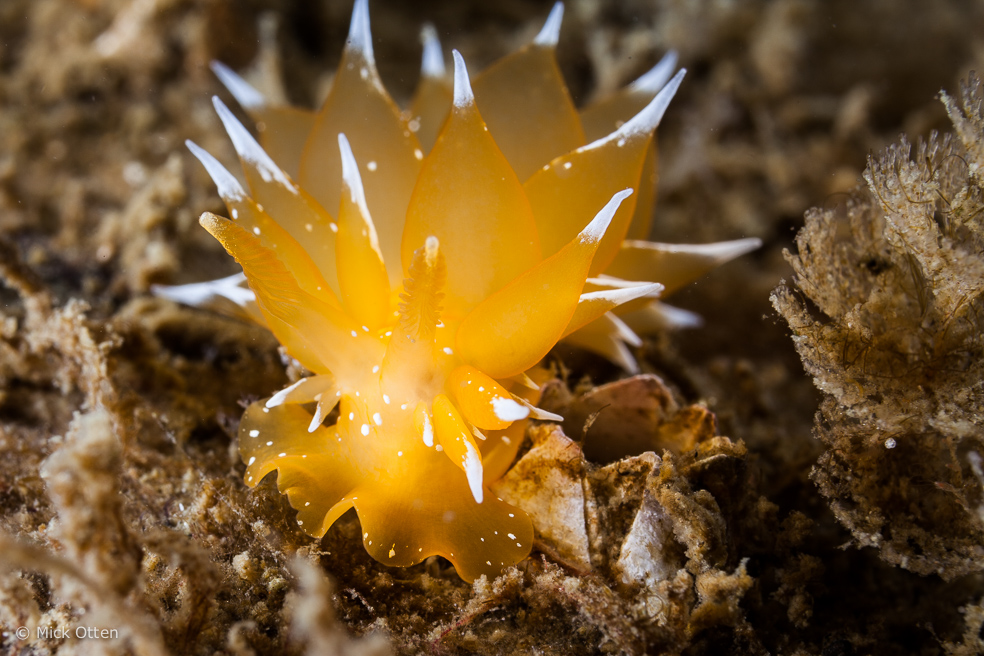
From the beast to the beauty: the long-mouthed aeolid, Himatina trophina. Behrens & Hermosillo (2005) state: to 5 cm in length, Lamb & Hanby (2005): up to 12 cm long. Maybe that the long-mouthed aeolids in northerly waters - the region covered in their book - are just bigger...

Himatina trophina, Rock Bay, Canada

Himatina trophina, Rock Bay, Canada

Lamb & Hanby (2005): 'The cores of the frilly cerata (gills) of this nudibranch are extensions of the creature's digestive tract and provide extra surface area for this proces.' In the photo above you can see a 'channel' running to and from the cores, especially at the back.

Himatina trophina & Elassochirus tenuimanus, Rock Bay, Canada

Although it is said that nudibranchs are no prey for animals like crabs and fish (see also the long-mouthed aeolid next to the english sole in this post), I have seen crabs eating the nudibranch Janolus cristatus, antiopella (NL: blauwtipje). Anyhow, this widehand hermit, Elassochirus tenuimanus, showed no interest in the long-mouthed aeolid.

Cadlina luteomarginata, Tyee Beach, Canada

The yellow-edged cadlina, Cadlina luteomarginata in its colourful biotope. Maybe in the direct vicinity of its prey? Like the orange rough ball sponge, Tethya californiana (top left) and the yellow boring sponge, Cliona californiana (the yellow spots middle left). Behrens & Hermosillo (2005): '.. feeds on a variety of sponges like Halichondria, Myxilla and Aplysilla.'

Cadlina luteomarginata, Tyee Beach, Canada

The yellow-edged cadlina grows up to 45 mm. Again larger in Lamb & Hanby (2005): 83 mm long.

Doris odhneri, Tyee Beach, Canada

The white nudibranch, Doris odhneri. Up to 20 cm long. I waited some time before the snail would extract its gills, the feather like organs at the back. Feeds on the sponge Halichondria (Behrens & Hermosillo, 2005).

Dirona pellucida, Rock Bay, Canada

The golden dirona, Dirona pellucida. Sometimes its hard to distuinguish head from tail in nudibranchs. Up to 12 cm.

Dirona pellucida, Rock Bay, Canada

Behrens & Hermosillo (2005): 'They feed on the bryozoan Bugula pacifica.'

Janolus fuscus, Rock Bay, Canada

I found this white-and-orange-tipped nudibranch, Janolus fuscus, just like the golden dirona, hanging on - mostly upside down - the jetty of Rock Bay.

Janolus fuscus, Rock Bay, Canada

Head or tail? You can distuinguish the rhinophores on the head at the top, because they are fringed and lack the orange ring. Up to 25 mm long. Behrens & Hermosillo (2005): 'They feed on the bryozoans Bugula and Tricellaria.'

Dendronotus rufus, Tyee Beach, Canada

A congregation of red dendronotids, Dendronotus rufus. Up to 28(!) cm long.
Behrens & Hermosillo (2005): 'Feeds on hydroids and scyphozoans.' 

Dendronotus rufus, Tyee Beach, Canada

No better pictures of this lovely nudibranch? Sorry, I got distracted by another interesting creature and forgot them... 

Haliotis kamtschatkana, Neck Point, Canada

A well camouflaged northern abalone, Haliotis kamtschatkana. Lamb & Hanby (2005): 'Populations of this species have been obliterated by overharvesting and fisheries mismanagement. ... Prospects for recovery are bleak indeed as illegal poaching activities outpace the many benefits of fishing closures.'

Haliotis kamtschatkana, Neck Point, Canada

Up to 18 cm long.

Haliotis kamtschatkana, Neck Point, Canada

An empty shell with mother of pearl inside.

Haliotis kamtschatkana, Neck Point, Canada

The same specimen with its beautiful red coloured outside. It is a well preserved specimen: at the left you can still see the 'original' abalone with its respiratory apertures. 

Lirabuccinum dirum, Neck Point, Canada

Hidden between seaweeds and moss animals: the dire whelk, Lirabuccinum dirum. Up to 5 cm long.

Lirabuccinum dirum, Rock Bay, Canada (staged)

Lamb & Hanby (2005): 'This active snail is a scavenger that particularly prefers injured prey, which it locates with susprising speed.'

Lirabuccinum dirum, Rock Bay, Canada (staged)

Head and mantle popping out. You can also see its operculum and eyes.

Fusitriton oregonensis, Neck Point, Canada 

The Oregon triton, Fusitriton oregonensis, up to 15 cm long, with its epidermis (upper layer) still intact. The epidermis wears off, especially in places with heavy surf.

Fusitriton oregonensis, Rock Bay, Canada 

Meinkoth (1981): 'The Oregon triton is an aggressive predator on molluscs and echinoderms, especially sea urchins. It rasps off the outer tissue and bores holes through the shell plates to get at the internal organs. Sometimes urchins are found with blackish scars resulting from encounters with this snail.' Reading this I wondered why this triton was rare, regarding the incredible amount of sea urchins at Rock Bay. See the next photo's.


Strongylocentrotus pallidus, Rock Bay, Canada 

Strongylocentrotus pallidus, Rock Bay, Canada

Ceratostoma foliatum, Rock Bay, Canada 

A couple of leafy hornmouths, Ceratostoma foliatum. A very common species at Rock Bay. Up to 10 cm long.  

Ceratostoma foliatum, Rock Bay, Canada 

It preys on oysters, but I found no oysters in Rock Bay. I presume it also preys on barnacles, just like its relative in the next photo, the Japanese rocksnail, Ocenebra inornata (NL: Japanse oesterboorder). In my aquarium small Japanese rocksnails (just as at Vancouver Island an import in the Netherlands) are preying on barnacles.

Ocenebra inornata, Gorishoek, The Netherlands

Ceratostoma foliatum, Rock Bay, Canada 

The darker coloured outgrowth shows the snail has grown strong in a short period of time. Otherwise part of it would have changed in the definitive colour. Compare with the more weathered specimen in the next photo.


Ceratostoma foliatum, Rock Bay, Canada 

Again showing its typical leafy ridges.

Nucella lamellosa, Rock Bay, Canada 

The wrinkled dogwinkle, Nucella lamellosa, shares the same biotope as the leafy hornmouth. Up to 12.5 cm long. At first I could not identify this snail. Friend and conchologist Herman Nijhuis identified it as Nucella lamellosa forma hormica (American Seashells by R. Tucker Abbot, 1974). As I looked this species up in Lamb & Hanby (2005) I found: 'Extremely variable shell colour, proportions and sculpturing often confuse the novice naturalist and expert alike.'

Mya truncata, Tyee Beach, Canada

Lying empty on the seafloor: the truncate softshell clam, Mya truncata (NL: afgeknotte strandgaper). Up to 8.5 cm.

Mya truncata, Tyee Beach, Canada

Even after the soft parts of the shell have vanished for months, the tough siphon coverings will be still in place.

Crassadoma gigantea, Neck Point, Canada

The giant rock scallop, Crassadoma gigantea, is almost invisible when closed. Up to 25 cm across.

Crassadoma gigantea, Neck Point, Canada

These specimen are overgrown with the same seaweeds, sponges, bryozoans and hydrozoans as their surroundings and the one above even becomes a resting place for the leather star, Dermasterias imbricata.

Crassadoma gigantea, Neck Point, Canada

Meinkoth (1981): 'This species develops and behaves like other scallops and is free-swimming until its valves grow to about 25 mm. At that time it settles on a solid object and its mantle secrets a limy material, cementing down the lower (right) shell and making the animal sedentary for the rest of its life.'

Crassadoma gigantea, Neck Point, Canada

The real beauty reveals itself: the orange mantle and the many, tiny black eyes.

Literature:
  • mainly: Lamb & Hanby, 2005
  • quoted: Behrens & Hermosillo, 2005 (excellent guide of Opisthobranchs from Alaska to Central America), Meinkoth, 1981 and Tucker Abbott, 1974.