4 September 2012

Ben Otten (1923-2012): instigator of my love for marine fauna and flora

On the 17th of June my father Ben Otten died at the age of 88. He was the instigator of my lifelong love for marine fauna and flora (and of many other people). In his lifetime he became an authority on Northwest European seaweeds. He left me and a few museums a beautiful collection of seaweeds. Just a hobby!

In Dutch: a in memoriam I wrote for Het Zeepaard (see Literature):

Op 17 juni dit jaar is Ben Otten overleden. Hij is zeer actief geweest binnen de Strandwerkgemeenschap. Als lid, als voorzitter en als auteur. Hoewel ik niet precies kan nagaan wanneer hij lid van de SWG is geworden, zal dat net als zijn lidmaatschap van de KNNV (van de afdeling Waterweg-Noord) in 1958 zijn geweest. Zijn belangstelling ging toen uit naar alles wat met mariene biologie te maken had. Hij was regelmatig het strand aan het afstruinen voor allerlei aanspoelsel. Omdat hij graag zijn kennis met anderen deelde, heeft hij samen met nog twee leden de Strandwerkgroep Waterweg-Noord opgericht.


Ben op excursie in Wimereux tijdens een strandwerkkamp in de Boulonnais

Vanuit die strandwerkgroep werden vanaf begin jaren ’60 kampen georganiseerd. Tussen Hemelvaart en Pinksteren naar de Boulonnais (Noord-Frankrijk) en later naar Bretagne en Normandië en weekendkampen in Zeeland. Het was een soort kruisbestuiving tussen gemeenschap en werkgroep: veel leden van de Strandwerkgemeen-
schap namen deel aan de kampen.

Als je Ben hebt gekend van een strandwerkkamp, dan zul je je hem vooral ook herinneren van na de excursies. Want dan ging hij er nog eens goed voor zitten en werd al het verzamelde materiaal zo goed mogelijk uitgezocht. Met microscoop en toen nog beperkte literatuur probeerde hij alles te determineren. Is voor mij strandwerk vooral beleving en minder studie, was dat bij Ben juist andersom. Herkennen van soorten in het veld was niet zijn sterkste punt. Hij wilde het tot achter de komma via een determinatietabel uitgezocht hebben, was daar ook zeer goed in en had er een ijzeren geduld voor. Ik ben een ‘plaatjeskijker’ waardoor ik soorten juist in het veld herken, determinatietabellen gebruiken nog steeds lastig vind en voor het thuis uitzoeken minder geduld heb. De wetenschapper versus de genieter. Hij vond dat wel jammer, want zo kreeg ik te weinig diepgang. Zijn karakter maakte het voor hem zelf wel eens lastig: hij ergerde zich aan het feit dat hij verzameld materiaal niet uit kon zoeken, omdat het zoveel tijd kostte. Bij de Frankrijk-kampen liet hij vaak de excursies op de laatste dagen aan zich voorbij gaan, zodat hij nog wat tijd had om het verzamelde tijdig op naam te krijgen.

Hij is van 1965 tot 1986 jaar voorzitter van de SWG geweest. Erg systematisch en consciëntieus was hij daarmee bezig. Ik kan mij hem nog herinneren in zijn ‘werkhok’ (een wat groot uitgevallen meterkast), de hangmappen en de typemachine met doorslagen. Hij heeft dat met veel plezier gedaan en vond het erg jammer dat hij – gedwongen door een nieuw huishoudelijk reglement – zijn voorzitterschap moest neerleggen. Ik heb wel eens begrepen dat hij dat erger vond dan met pensioen te moeten.


Eén van de vele door Ben ingelegde zeewieren. Uiteraard met naam, datum en plaatsvermelding.

Was zijn belangstelling bij de start breed, halverwege de jaren ’70 is hij zich steeds meer gaan specialiseren op het gebied van zeewieren. Daar ging het leeuwendeel van zijn vrije tijd en liefde in zitten. Verzamelde zeewieren bracht hij op naam en als het in zijn ogen de moeite loonde, legde hij ze in. Dan moest hij van een – zoals hij dat noemde – natte kat iets toonbaars maken. Dat werden in veel gevallen halve kunstwerken. Tijdrovend maar met veel eer van zijn werk. De zeewieren die hij niet tijdig uit kon zoeken, gingen op de formol om later gedetermineerd te worden. Dat wat hij niet in zijn verzameling op wilde nemen of (meer dan) dubbel had, ging al of niet ingelijst naar familie en vrienden. Een deel van zijn collectie ging naar het huidige Naturalis en werd daar door vrienden in de vaste expositie herkend aan zijn kenmerkende handschrift! Hij had zich ontwikkeld tot één van de autoriteiten op zeewiergebied in Nederland.


Ook een wier uit de collectie van Ben. Met zijn kenmerkende handschrift.

Dat wat hij niet op naam kreeg of waar hij twijfelde, werd voorgelegd aan algologen als Willem Prud’homme van Reine, Frank Perk, Paulette Gayrall (Frankrijk) en later vooral Herre Stegenga. Solo en als co-auteur heeft hij een groot aantal publicaties in Het Zeepaard op zijn naam staan. Die kun je terugvinden op de CD met alle jaargangen van Het Zeepaard, die vorig jaar is uitgebracht. Zoeken met veel geduld omdat zijn Zeepaarden zijn gescand voor die CD en systematisch als hij was: hij voorzag altijd elk nummer met een naamstempel… Samen met Arthur Oosterbaan heeft hij de minitabel Hydropoliep of mosdiertje? gemaakt. Verder is Ben jarenlang gastconservator zeewieren geweest van het Natuurhistorisch Museum Rotterdam.

Op excursies en de genoemde kampen vertelde en onderwees hij altijd met veel enthousiasme. Een educatieveling in hart en nieren. En bleef nut en noodzaak van determinatie volgens de tabellen benadrukken! Bij de Strandwerkgroep Waterweg-Noord was hij tot een aantal jaren geleden één van de drijvende krachten en verzorgde veel inleidingen op de werkgroepavonden.

Tot een jaar of acht geleden hield hij zich met zijn geliefde zeewieren bezig. Dat was overigens al lang niet meer buiten: al veel eerder lieten zijn knieën hem in de steek, waardoor het lopen over de stenen onderaan de dijken te pijnlijk was.
Hij merkte dat het hem steeds meer moeite en energie kostte om ze op naam te brengen. Hij vond dat ‘zeer onprettig’: het wees hem teveel op zijn falende geheugen en vermogens. Het plezier was er - net als in het dagelijkse leven – wel vanaf. Zijn wierencollectie heb ik van hem gekregen.
Het overlijden kwam gezien zijn leeftijd van 88 jaar, Parkinson en andere kleine gebreken niet helemaal als verrassing. Bij de uitvaart had hij graag nog even aangezeten bij het tafeltje waar vier zeewierspecialisten zich hadden verzameld.

Dat ik zelf goede herinneringen aan mijn vader heb, spreekt haast voor zich. Het is toch mooi dat je voor zo’n hobby – haast levenstaak – enthousiast bent gemaakt en overneemt. Ik schreef een aantal jaren geleden voor hem, toen hij al langer geen excursies meer kon lopen, de volgende tekst: ‘Ik ben een solist. Strandwerk doe ik uitstekend in m’n uppie. Maar het elkaar tegenkomen op zo’n Bretonse kustvlakte en dan vondsten en verhalen uitwisselen, de kennis en het enthousiasme delen, de wetenschap dat er daar ergens je strandwerkkameraad rondloopt, de gezelligheid voor en na de excursies. Ja, dat mis ik wel.’ Hij dacht daar niet anders over.

27 August 2012

Sepiola atlantica: cute Atlantic bobtail

  Atlantic bobtail, Sepiola atlantica (NL: Dwerginktvis). 't Koepeltje, the Netherlands, 15-8-2012. 

Two weeks ago we went to dive at Scharendijke, a divespot in the Grevelingenmeer. Unfortunately the place was crowded with divers. That means a lot of disturbance of the bottom, resulting in cloudy water. So we went to 't Koepeltje (also in the Grevelingenmeer, one of the divespots in the province of Zeeland with rather clear water.

For the first hour I saw a lot of fish (gunnels, two-spotted gobies) and crabs (edible crabs, arch-fronted swimming crabs, common lobsters etc.). Nice but nothing new. Till I saw a strange patch in the sand.

  Atlantic bobtail, Sepiola atlantica (NL: Dwerginktvis). 't Koepeltje, the Netherlands, 15-8-2012. 

That appeared to be the Atlantic bobtail, Sepiola atlantica (NL: Dwerginktvis).

  Atlantic bobtail, Sepiola atlantica (NL: Dwerginktvis). 't Koepeltje, the Netherlands, 15-8-2012. 

Typically hiding in the sand with only its big eyes exposed.


  Atlantic bobtail, Sepiola atlantica (NL: Dwerginktvis). 't Koepeltje, the Netherlands, 15-8-2012. 

Now you're pissing me off: when annoyed this Bobtail changes colour from sandy pale to brown red in less than a second.


  Atlantic bobtail, Sepiola atlantica (NL: Dwerginktvis). 't Koepeltje, the Netherlands, 15-8-2012. 

At first it looks like a juvenile of the Common cuttlefish, Sepia officinalis (as I will show in a next post), but it is rather different. Its eyes are bigger, it is cup-shaped, the fins are different and it has more coloured chromatophores. They can grow up to 5 cm. This specimen was about 4 cm.


  Atlantic bobtail, Sepiola atlantica (NL: Dwerginktvis). 't Koepeltje, the Netherlands, 15-8-2012. 

It was my first encounter with this very cute Bobtail while diving. In fact the photo's in this post are of two specimen. When the first one swam away (and I followed it cautiously) it landed exactly on a spot where another Sepiola was hiding! Sepiola 2 chased the first one away. So then I teased Sepiola 2 for a while taking photo's: it was evident that they didn't like me (ugly and big) and especially my flashlights. Sorry! And believe it or not: Sepiola 2 landed a short time later on the spot where Sepiola 1 was hiding and so now he was chased away.


  Atlantic bobtail, Sepiola atlantica (NL: Dwerginktvis). 't Koepeltje, the Netherlands, 15-8-2012. 

The tube underneath its body is jet propulsion avant la lettre. It is a swift swimmer, but not as quick as the Common cuttlefish (Sepia officinalis) or Common squid (Loligo species).


  Atlantic bobtail, Sepiola atlantica (NL: Dwerginktvis). 't Koepeltje, the Netherlands, 15-8-2012. 


  Atlantic bobtail, Sepiola atlantica (NL: Dwerginktvis). 't Koepeltje, the Netherlands, 15-8-2012. 
Sepiola has landed.

27 February 2012

Taking photo's, selecting, processing and... enjoying!


I had my last dive at December 11th. The water temperature was still okay: 6ºC. But, when diving in wetsuites, the problem is not in but out of the water. Drying yourself, getting warm, uninstalling your diving gear, cold fingers, toes and nose. Ready to catch a cold.

So instead of diving I have been browsing, selecting and processing hundreds of photo's I took of marine life in the Netherlands. In part it is like armchair discovery of marine life. When browsing photo's at 100% on my 23 inch display I regurlarly discover animals I hadn't noticed while diving. Like miniscule nudibranchs on hydropolyps. I try to identify every organism on my photo's. That takes a lot of time and isn't always possible. Sometimes the photo isn't good enough (not sharp enough, not enough contrast, too tiny), sometimes you just need to see another part of that animal or seaweed.

In their habitat: attached to shells or stones in sand or silt.

This post is about photo's I took of the small snakelocks anemone, Sagartiogeton undatus (NL: weduweroos). It is a stunning beautiful sea anemone and one of my favourites in the Netherlands.
Expanded anemone showing its column. Not the typical habitat of this anemone.

I try to take photo's of animals at their loveliest, but I also want to document the characteristics, behaviour and habitat. Just like my great source of inspiration: the exquisite images T.A. Stephenson (1935) made for The British Sea Anemones (bottom half image below).


I already had a few nice photo's of this beautiful sea anemone. But sometimes the conditions are better: clear water and a nice background. Or it's moving, eating or showing some kind of behaviour. That will always trigger me to try again.

Habitat: it looks like the specimen in the lower right corner is living in a tube like the burrowing anemone, Cerianthus lloydii (NL: viltkokeranemoon). That is not the case: the silt is compressed when the anemone is fully expanded.
Nice, but I don't like the white 'blob' behind the anemone (Didemnum vexillum, NL: druipzakpijp). One of the biggest challenges is finding an animal without white (flash reflecting) spots in the neighbourhood. Think about surrounding white shells and reflecting sandparticles....
Behaviour: one of my favourites with an expanded mouth. Give me a kiss!
Characteristic: the white line along the length of the tentacles.
My favourite at the moment. Beautiful colours, the composition I wanted, sharp where it is supposed to be sharp, nice backgroud and lighting. Or do I prefer the cropped first photo of this post (not the same photo) or the next more dynamic photo of the same specimen? What do you think?


So, you always try to do better. In the meantime enjoy the photo's you made!

All these photo's were taken in the Grevelingen (divespots Den Osse, Dreischor, 't Koepeltje). The small snakelocks anemone prefers rather stagnant waters, as in the Grevelingen. At certain spots it is abundant and even the most common anemone. It is also fairly common in the Oosterschelde.

5 January 2012

A glimpse of invertebrate marine life of Newfoundland (part 6)


The brittle star Ophioderma brevispina.

I made two snorkeling trips: one at Open Hall and one at Salvage. Have a look at this post for other pictures of Salvage and Open Hall. Apart from Asterias, Eudendrium, an unknown species and Tamiasciurus all photo's were made at Salvage.

The green sea urchin, Strongylocentrotus droebachiensis.

Detail: between the spines you can see tubefeet. They use the tubefeet for locomotion and to attach weeds, (particles of) shells etc. It is said for camouflage, but some urchins do and some don't at the same spot. And those that camouflage themself, regurlarly make a lousy job of it. See for the picture further on of the green sea urchin carrying a (living) periwinkle.
A bit overcrowded?

The tortoiseshell limpet, Testudinalia testudinalis. Just as the green sea urchin and the periwinkle (next photo) they predate on seaweeds and keep the rocks on which they grow 'tidy'.

The common periwinkle, Littorina littorea (NL: gewone alikruik). At left just visible a dog whelk, Nucella lapillus (NL: purperslak).
A lot of shells (mussels) and crabs (Cancer) looked quite eroded. This periwinkle has a lot of scars. I think the slits are caused by crabs. But the holes? Dog whelks drill holes in shells, but these holes are very crude.


The common mussel, Mytilus edulis (NL: mossel).


The acorn barnacle, Semibalanus balanoides (NL: gewone zeepok) in different growth stadia.


The atlantic rock crab, Cancer irroratus. This specimen looked very worn and was quite slow.

This one wasn't slow! The specimens I found were small: up to 8 cm. It can grow up to 13 cm wide. A lot smaller than its European nephew Cancer pagurus, which can grow up to 30 cm wide. For this species and other relatives of Cancer irroratus have a look here.


A gunnel, Pholis gunnellus (NL: botervis) hiding near a green sea urchin. Robbins' description (1986; see literature page) points it to another species: Pholis fasciata, the banded gunnel. I think he is mistaken.

The common starfish, Asterias rubens (NL: gewone zeester) in cometform (NL: komeetvorm). The starfish lost 4 of its 5 legs, which are now regenerating.
The brittle star Ophioderma brevispina wasn't pleased when I turned the rock it was hiding under. Most brittle stars become active at night and quickly hide when exposed to light.
Probably stick hydroids, a Eudendrium species (NL: haarpijpje) growing on bladder wrack, Fucus vesiculosus (NL: blaaswier).

Hardly visible (right/upper halve): Stauromedusa species, stalked jellyfish (NL: steelkwal), another cnidarian but belonging to the Scyphozoa (jellyfishes).

I am not sure, but I think that these very tiny creatures are flatworms (phylum Platyhelminthes).


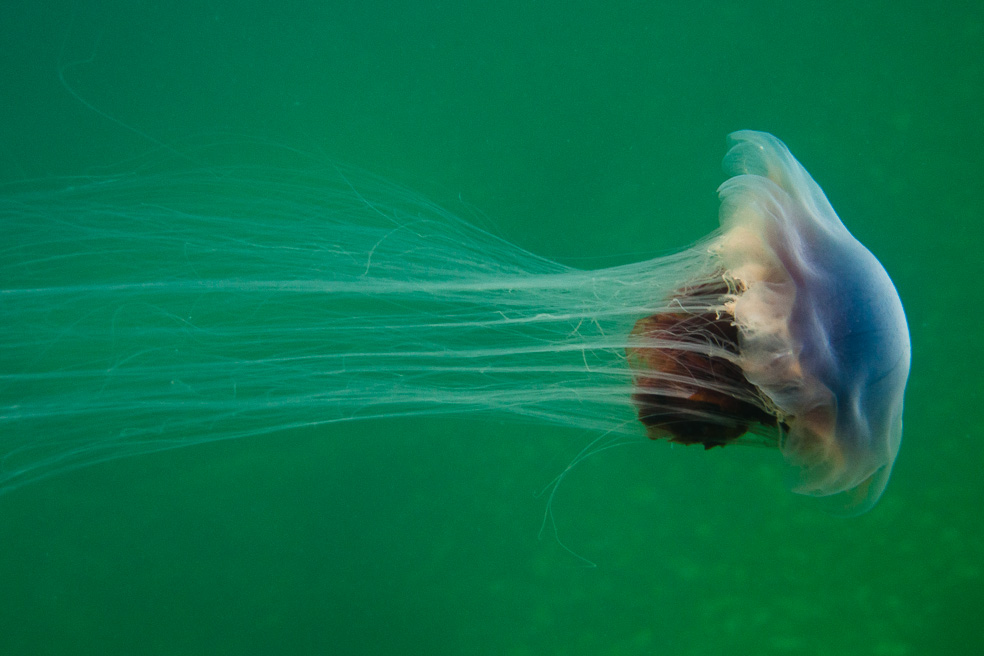
The lion's mane jellyfish, Cyanea capillata (NL: gele haarkwal). The world's biggest jellyfish with a bell diameter of up to 2,5 metres and tentacles as long as 30 metres! This one was only 30 cm wide. It can inflict painful stings.


The biggest specimen I ever saw, was washed up on a beach in the Oosterschelde. It had a bell diametre of 1 metre and was thin as a dime. Before I found it I was wondering where a strong fishy smell originated from. Yes: this jellyfish!
Not an invertebrate but I can't resist showing this cute American red squirrel, Tamiasciurus hudsonicus. It was running up and down the wharf at Open Hall. It is not native to Newfoundland, but introduced in 1963. In the same year as the chipmunk, which 'Newfies' regard as vermin.